
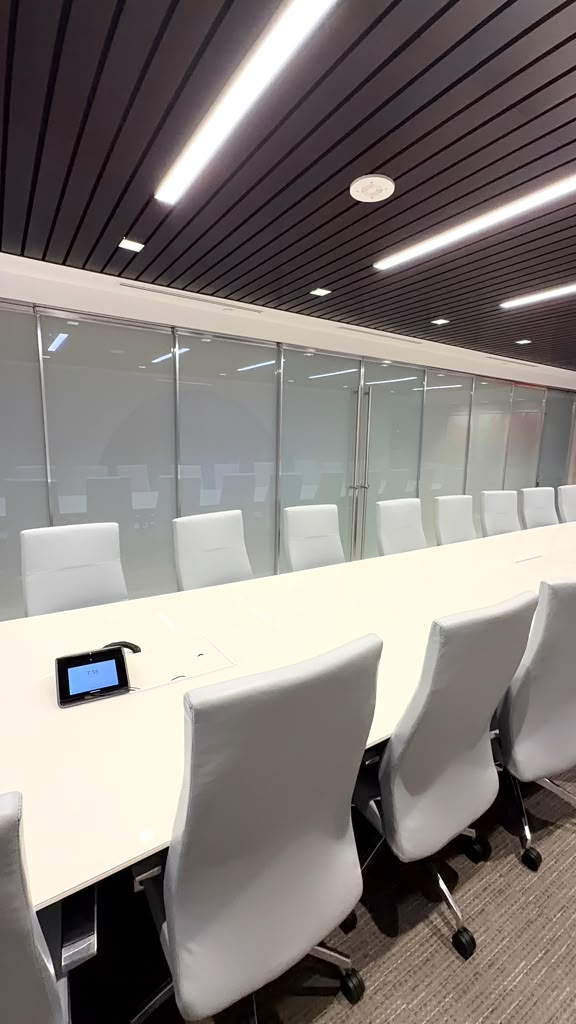
Smart film gives a glass wall two jobs. In one mode, it keeps a space open and connected. In another, it creates instant privacy for meetings, treatment rooms, home offices, and shared spaces. It is one of those upgrades that feels a little futuristic until you realize how practical it is on a busy Tuesday.
Where smart film earns its place
Switchable privacy film is especially useful where clear glass looks beautiful but does not always match the moment. Think conference rooms, executive offices, clinics, wellness rooms, hospitality spaces, interior partitions, and select home applications. It can turn a transparent room into a private one without hanging blinds across a clean glass wall.
The best applications are not chosen simply because the technology is impressive. They are chosen because a space genuinely needs both openness and privacy. Falcones can review the room, glass layout, power planning, and the daily use case before recommending a direction.
- Conference rooms that need privacy on demand
- Medical, wellness, and consultation spaces with changing needs
- Home offices, glass doors, and interior partitions where flexibility matters
Plan the experience, not only the film
Smart film is a system, so the conversation includes the glass, electrical access, controls, edge finishing, and how people will use the room. A good plan considers whether the switch should be at the door, tied to a room control, or set up around a more specific workflow.
For an office, the question may be whether people need private meetings without losing a transparent design language. For a home, it may be whether a room needs privacy without permanently closing it off. The details matter because the most satisfying installations feel natural to use from day one.
Questions to ask before a smart-film consultation
Have a few answers ready: Which glass needs privacy? When is privacy needed? Who controls the film? Is there nearby power? What should the space look like when the film is clear and when it is private? Those answers create a far better starting point than the classic request of, 'Can we make it look cool?' Although yes, that part is welcome too.
Falcones can use photos, measurements, and a site conversation to outline a useful next step. Smart film is an investment in the way a space functions, so it benefits from an intentional scope and a clean installation plan.
- Do measure the glass and photograph the surrounding space
- Do identify electrical access and the preferred control method early
- Do not treat smart film as a drop-in replacement without reviewing the installation details
Questions Falcones hears often
Can smart film be used in homes and offices?
Yes. It can be considered for residential and commercial interior glass where the space benefits from both visual openness and on-demand privacy.
Does smart film need planning beyond the glass size?
Yes. The project should account for power, controls, wiring routes, glass condition, edge finishing, and how the occupants need the privacy feature to work.